


Read four articles about getting traffic to an Etsy shop and you will notice something odd. They tell you to promote your best sellers, email your past buyers, showcase your positive reviews and study your stats. A shop that opened eleven days ago has no best sellers, no past buyers, no reviews and almost no stats. The advice is not wrong, it is just written for a different shop than the one asking the question.
So this piece is organised the other way round. It starts from the position you are actually in, which is zero history, and puts the work in an order. Order is the part nobody writes down, and for a new shop the order matters more than the list, because doing the right thing in the wrong month wastes money you do not have yet.
One framing to carry through all of it. Etsy is a search engine attached to a marketplace. The traffic Etsy sends you is decided by an algorithm you can influence but not instruct. The traffic you send yourself is decided by you. Those are two separate projects with two separate timelines, and confusing them is why so many new sellers spend month one on Instagram and month six wondering why they never show up in Etsy search.
First, the honest expectation
Etsy publishes a conversion benchmark, which is rarer than it should be. In its own seller guidance Etsy says that in general, sellers should expect a conversion rate between one and five percent, while noting that a good rate looks different for every shop and varies significantly across categories and price points.
Sit with that number for a second, because it silently sets the traffic target for everything below. At two percent, one sale requires around fifty visits. At one percent it requires a hundred. If your shop has had ninety visits this month and no orders, you are not looking at a broken shop, you are looking at a sample too small to have produced an outcome yet. The problem in month one is almost never conversion. It is volume.
That reframes the whole job. You are not trying to fix a leak. You are trying to get enough water through the pipe to find out whether there is one.
Week one: everything that is free, permanent, and only has to be done once
The first week is not a marketing week. It is a foundations week, and every item on this list is a one-off that keeps paying afterwards. Skipping it to go and post on Instagram is the classic new-seller mistake, because the Instagram post is gone in a day and the shop policies are there for two years.
- Fill out your shop policies completely, including shipping and returns. Etsy's own first-steps guidance for new sellers puts this under building buyer trust, and an incomplete policies page is visible to every shopper who checks.
- Write the About section properly and put photos in it. It is the only place on Etsy where a stranger can decide they like you, and on a shop with no reviews yet it is doing the work reviews would otherwise do.
- Fill in every attribute and choose the most specific category available for each listing. This is not admin. Etsy states plainly that categories and attributes act like tags, so a half-filled attribute panel is unused keyword real estate.
- Get shipping under six dollars for US domestic if you possibly can. Since October 2024 Etsy prioritises listings with domestic shipping under that figure in search, on the reasoning that buyers become less likely to purchase at six dollars and above. This is a ranking factor most new sellers never hear about.
- Use all thirteen tags on every listing, in multi-word phrases rather than single words, and do not repeat what your categories already say.
- Add more than five listings. Etsy's own guidance for new shops is blunt about it: a well stocked shop shows shoppers your business is legitimate. It is also simple arithmetic, which the next section covers.
None of this is exciting and all of it compounds. A shop that does week one properly gets more out of every subsequent effort, because the traffic it eventually earns lands on a page that converts.
The listing-count arithmetic nobody writes down
This is the single highest leverage thing available to a shop with no traffic, and it is usually buried as tip number nine in a listicle.
Each listing is an independent entry point into Etsy search. Each carries its own thirteen tags, its own title, its own category and attributes. Five listings gives you roughly sixty-five tag slots across five entry points. Thirty listings gives you nearly four hundred across thirty. You are not thirty times more likely to be found, because your listings will overlap and compete, but you are dramatically more likely to be found for something, and in month one being found for something is the whole objective.
There is a second effect, and it is the one that makes this the strongest lever a new shop has. Etsy documents a small temporary boost for newly created listings, lasting anywhere from a few hours to a few days, given so that Etsy search can learn how buyers interact with the listing and work out its engagement rate. Etsy's own legal disclosure defines recency as how recently an item was listed or relisted.
Read that carefully, because it is routinely oversold. The boost is small, it is short, and its purpose is data collection rather than reward. What it is not is a reason to renew listings daily at twenty cents each, which Etsy has never endorsed and which no Etsy documentation supports. What it does mean is that a steady drip of genuinely new listings gives your shop a repeated, legitimate reason to be sampled by Etsy search. One or two new listings a week, sustained, does more for a young shop than any single marketing push.
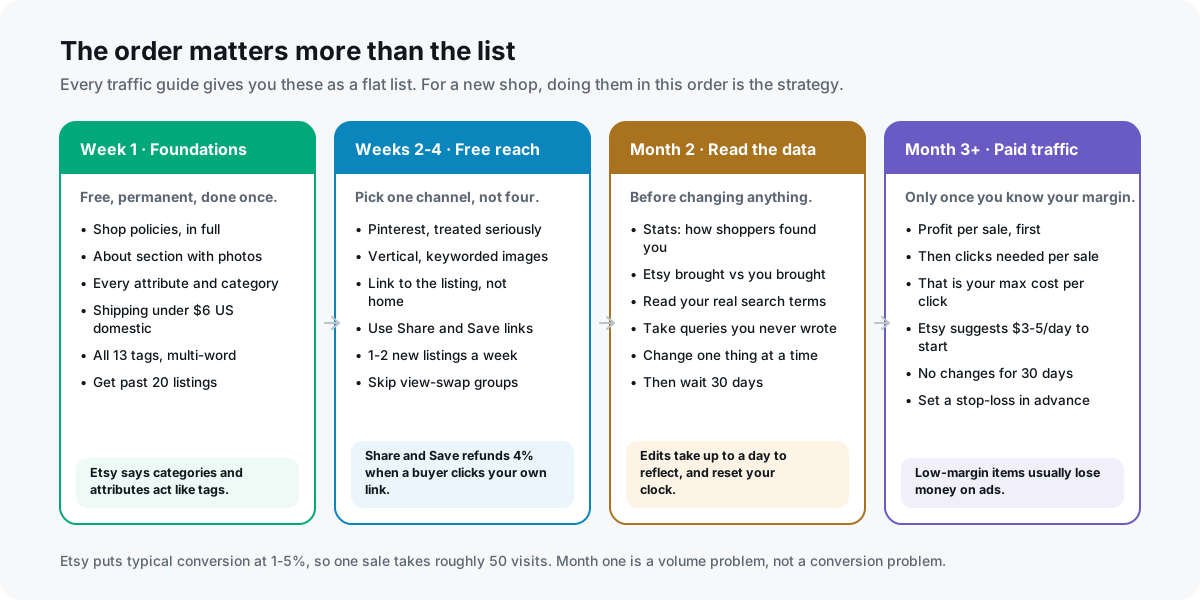
Weeks two to four: free reach, chosen properly
Now you can look outward. Two things to get straight before you do.
First, the claim that driving external traffic boosts your Etsy search ranking is repeated everywhere and Etsy has never documented it. Etsy lists social media under promoting your shop, framed as a way to reach more shoppers, not as a ranking input. What is documented is listing engagement rate, which is how many people view a listing and then buy. So the honest chain is this: external traffic can produce sales, sales feed engagement rate, and engagement rate is a ranking factor. That chain is real, but it runs through sales, not through visits. Sending a thousand uninterested people to a listing does not help you and may quietly hurt you by dragging the ratio down.
Second, pick one channel. A new shop run by one person cannot sustain four social accounts, and four neglected accounts perform worse than one maintained one.
For most Etsy categories the channel worth choosing is Pinterest, and it usually gets folded into a generic "post on social media" bullet that does it no justice. Pinterest behaves like a visual search engine rather than a feed, which means a pin has a long tail rather than a twelve-hour life, and the person searching there is looking for something to buy or make rather than being interrupted mid-scroll. The mechanics that matter are unglamorous: vertical images, readable text on the image itself, a keyword-written description, and the pin linking directly to the listing rather than to your shop home.
There is one Etsy feature worth using the moment you start sending your own traffic, and most new sellers have never heard of it. Etsy's Share and Save program gives you an instant refund of four percent of the eligible order total when a buyer places an order within thirty days of clicking a link you shared, using the trackable link format Etsy generates in Shop Manager. It is a fee credit rather than a ranking lever, and there is a catch worth knowing: links sent through Etsy Messages or placed in listing descriptions do not count. If you are going to post links anyway, post the ones that pay you back.
Month two: read the data before you change anything
By now you should have enough traffic to read rather than guess. Open Stats and look at How shoppers found you, which splits into traffic Etsy brought you, meaning Etsy search, the Etsy app and other Etsy pages, and Etsy marketing and SEO, and traffic you brought, meaning direct, social media, Etsy Ads and Offsite Ads.
That split is the most useful diagnostic on the platform and hardly anyone uses it as one. It answers a question you cannot answer any other way: is Etsy finding me, or am I the only one driving anything here? A shop where nearly all traffic sits under traffic you brought has a search visibility problem no amount of extra posting will fix. A shop where Etsy search is delivering visits that never convert has the opposite problem.
Under Etsy search you can also see the actual search terms shoppers used to find you. Every phrase in that list that you never wrote as a tag is a proven query with demand behind it, which makes it a better tag candidate than anything you can invent. This is the cheapest keyword research available anywhere, and it is sitting inside your own dashboard.
Change one thing at a time and give it a month. Etsy states that edits can take up to a day to reflect in search, and editing also re-triggers the recency effect, so a listing rewritten every four days never produces a clean reading of anything.
Month three: paid traffic, and the arithmetic first
Etsy Ads are the fastest way to buy visits and the fastest way for a new seller to lose money, and the difference is entirely whether you did the arithmetic beforehand. Almost every article that recommends ads gives no budget, no break-even and no stop rule. Here are all three.
The mechanics, from Etsy. The minimum daily budget is one dollar. New sellers start with a maximum daily budget of twenty-five dollars, recalculated weekly based on the previous seven days of spend. You are charged only when someone clicks, never for an impression. The budget is a hard cap: once it is spent for the day, Etsy stops showing your ads. Etsy sets the bid for each listing itself, based on expected sales from a click, so there is no bid to tune. Etsy's own recommendation is a starting daily budget of at least three to five dollars, and to make no adjustments for at least thirty days because it uses that time to identify trends.
Now the part that decides whether any of that is a good idea. Work out your profit per sale before you spend a cent. Take your item price, subtract your cost of goods, then subtract Etsy's cuts: the 20 cent listing fee, the 6.5 percent transaction fee, which Etsy applies to the shipping and gift wrapping you charge as well as the item price, and payment processing, which in the US is 3 percent plus 25 cents. What remains is what one sale is actually worth to you.
Then the break-even. If a sale nets you eight dollars and your ads convert at two percent, you need fifty clicks per sale, which means eight dollars divided by fifty, or sixteen cents per click, to break even. At a realistic cost per click that is a losing trade, and running it for a month at five dollars a day burns a hundred and fifty dollars to learn something you could have calculated in ten minutes. Change the numbers and it flips: a sale that nets forty dollars at the same conversion rate can carry eighty cents a click comfortably.
So the rule is simple. Low-margin items should not be advertised by a new shop, no matter what the tactic lists say. And set a stop-loss before you start: a fixed amount you are willing to spend to learn, written down in advance, at which point you stop regardless of how promising it feels.
One more figure worth knowing before it surprises you, because it is not optional. Offsite Ads are separate from Etsy Ads and are run by Etsy on Google, Facebook, Instagram, Pinterest and Bing. Every shop is enrolled automatically. Under ten thousand dollars in sales over a rolling 365-day period you can opt out; at or above it, participation becomes mandatory for the lifetime of the shop and the fee drops from fifteen percent to twelve. The fee is charged on the order total when a buyer clicks one of those ads and buys within thirty days, capped at a hundred dollars per order. That is a fee on your revenue, not on ad spend, sitting on top of the 6.5 percent transaction fee. Price accordingly.
What not to do, and why
- Do not join view-swap groups or ask for views in forums. Etsy weighs listing engagement rate, which is views against purchases. Visits from people who will never buy make that ratio worse, not better.
- Do not renew listings daily hoping for the recency boost. It is documented, it is small, it lasts hours to days, and Etsy has never presented renewal as a ranking tactic. At twenty cents a renewal across thirty listings you are spending real money to reset your own measurement window.
- Do not rewrite your tags every few days. Etsy says edits take up to a day to reflect in search, and every edit restarts the clock. Constant edits guarantee you never learn which change worked.
- Do not run a sitewide sale in month one to force traffic. You have no baseline yet, so you cannot tell whether the sale did anything, and you have trained your first buyers to expect a discount.
- Do not read forum threads about traffic collapsing as evidence about your own shop. Those threads are overwhelmingly established sellers describing a decline from a high base. A shop with no traffic yet is not experiencing a decline. It is experiencing the beginning.
If you only do three things
For a shop under three months old, in priority order: add listings steadily, because every listing is a new entry point and a fresh, legitimate recency signal. Fill in every attribute and category, because Etsy treats them like tags and most sellers leave them half done. And read the Etsy search terms in your own Stats every month, because your buyers are telling you the words they use and no paid tool has better data about your shop than your shop does.
Everything else on this page is real and worth doing. Those three are the ones that work while you sleep.
Before you set an ad budget, work out what a sale is actually worth to you. The free Etsy Fee Calculator shows what Etsy really takes per sale, including the Offsite Ads fee most calculators leave out, so your break-even is a real number rather than a guess. →Frequently asked questions
How long does it take for a new Etsy shop to get traffic?
Etsy says a newly published listing can take up to 48 hours to appear in search results and categories, so the first visits can arrive within days. Meaningful, readable traffic is a different question and usually takes weeks, and depends far more on how many listings you have than on how long the shop has existed.
How many listings do I need before traffic picks up?
Etsy does not publish a number, and anyone who quotes one precisely is guessing. What is arithmetic rather than opinion is that each listing is a separate entry point with its own thirteen tags, so five listings give you far fewer chances to match a search than thirty. Etsy's own new-seller guidance says a well stocked shop shows shoppers your business is legitimate.
Does posting on social media improve my Etsy search ranking?
Etsy has never claimed this. Social media appears in Etsy's guidance as a way to reach more shoppers, not as a ranking factor. The real connection runs through sales: external traffic can produce sales, and Etsy does count listing engagement rate, meaning views that turn into purchases, as a ranking input. Traffic that never buys does not help and can drag that ratio down.
Is the new listing boost real?
Yes, and it is more modest than most advice suggests. Etsy documents it under recency: a new listing gets a small, temporary boost so Etsy search can learn how buyers interact with it and determine its engagement rate, lasting anywhere from a few hours to a few days. Etsy's legal disclosure confirms that relisting counts as recent too, but Etsy has never presented repeated renewal as a growth strategy.
Should a brand new shop run Etsy Ads?
Only after working out profit per sale. Etsy's minimum daily budget is one dollar and it recommends starting at three to five, charging only on clicks, with new sellers capped at twenty-five dollars a day. But whether that is money well spent depends entirely on margin: if a sale nets you eight dollars and ads convert at two percent, you need fifty clicks per sale and cannot pay more than sixteen cents a click to break even. Low-margin items are usually a losing trade for a new shop.
What is a normal conversion rate on Etsy?
Etsy's own guidance says sellers should generally expect between one and five percent, while noting it varies significantly by category and price point and is best measured over longer periods. At two percent, roughly fifty visits produce one sale, which is the arithmetic that makes a quiet first month look far less alarming.
Can I opt out of Offsite Ads?
Only below the threshold. Every shop is enrolled automatically, and shops with under ten thousand dollars in sales over a rolling 365-day period can opt out. Once a shop crosses that figure, participation becomes mandatory for the lifetime of the shop, with the fee dropping from fifteen percent to twelve of the order total, capped at a hundred dollars per order.
Which social platform is best for driving Etsy traffic?
For most Etsy categories, Pinterest, because it behaves like a visual search engine rather than a feed. A pin keeps working for months while a story disappears in a day, and the person searching there already has buying or making intent. The more important point is to pick one channel and maintain it rather than opening four accounts you cannot sustain.
Is it worth putting my Etsy links everywhere I can?
If you are sharing links anyway, use the trackable links Etsy generates in Shop Manager. Etsy's Share and Save program refunds four percent of the eligible order total when a buyer orders within thirty days of clicking your shared link. Links sent through Etsy Messages or placed in listing descriptions do not count towards it.
My shop has visits but no sales. Is that a traffic problem?
No, that is a conversion problem, and it needs the opposite response. More traffic to a listing that does not convert just spends effort proving the same point. Look at the first photo, the price relative to what else appeared in that search, the shipping cost, and whether the listing has any reviews yet. But check the volume first: at a one to five percent conversion rate, under a hundred visits is not yet a large enough sample to conclude anything.
The short version
Do the permanent things first, because they keep working. Add listings steadily, because that is both more entry points and a legitimate recency signal. Pick one external channel rather than four. Read your own Stats before changing anything, and change one thing at a time. Do not buy traffic until you know what a sale is worth to you.
And give it more time than feels reasonable. A shop with ninety visits and no sales has not failed a test. It has not finished taking one.